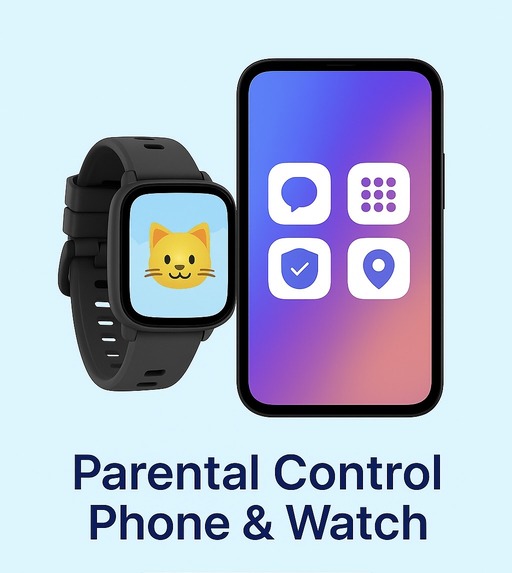
✔ Detects cyberbullying, predators, & threats
✔ Tracks real-time GPS location
✔ Sends instant alerts for risky activity
✔ Blocks explicit, violent, or unsafe websites
✔ Sets screen-time limits and bedtime schedules
✔ Lets parents approve contacts & apps
✔ Keeps data private & secure
📊 10 Shocking Statistics About Kids’ Screen Use You Need to Know in 2025
Screens are everywhere — classrooms, bedrooms, backpacks, even playgrounds.
For most kids, phones aren’t just tools anymore; they’re companions.
But how much screen time is too much? And what’s really happening behind those glowing screens?
We gathered the latest data from trusted digital wellness studies, tech safety organizations, and psychology experts — and the results are eye-opening.
If you’re a parent trying to understand your child’s digital world, these 10 statistics reveal what’s really at stake — and how parental-controlled kids’ phones can bring back balance.
📱 1. Kids Spend an Average of 7.6 Hours Daily on Screens
According to Common Sense Media’s 2025 Report, children ages 8–14 now average 7.6 hours of daily screen time, excluding schoolwork.
That’s nearly half their waking day — mostly on entertainment, gaming, and social apps.
🔑 Why it matters: Overexposure to screens reduces focus, emotional regulation, and real-world social engagement.
💬 82% of Kids Use Messaging Apps by Age 11
Most tweens now text or message daily — even if they don’t have a full smartphone.
The SafeKids Tech Survey 2025 found that 82% of 10–12-year-olds use at least one messaging platform.
🔑 Why it matters: Messaging is social — but unmonitored chats can expose kids to strangers, bullying, or inappropriate content.
🧠 Attention Spans Have Dropped 25% Since 2019
A multi-year brain study by the Child Focus Institute revealed that average focus duration in children dropped 25% in six years, directly linked to constant phone notifications and multitasking.
🔑 Solution: Structured “focus time” on kids’ phones with parental controls helps retrain attention through scheduled downtime.
🕰️ 1 in 3 Kids Checks Their Phone Within 5 Minutes of Waking Up
Morning scroll is the new normal.
The Family Digital Wellness Project found that 34% of children grab their phones within five minutes of waking up.
🔑 Why it matters: This early stimulation triggers stress hormones and disrupts calm, focused starts to the day.
🌙 61% of Kids Sleep with Their Phone Nearby
More than half of children now keep their phone beside their bed.
Sleep studies show this leads to 1.5 fewer hours of quality rest and higher anxiety.
🔑 Fix: Use built-in bedtime modes on kids’ phones to power down at night automatically.
😟 44% of Kids Feel “Anxious or Left Out” Without Their Phone
The Youth Digital Behavior Survey found that nearly half of kids feel social anxiety when separated from their device for more than two hours.
🔑 Insight: This “digital FOMO” can be reduced by balancing screen limits and emphasizing offline bonding.
🧩 Only 29% of Parents Feel in Control of Their Child’s Phone Use
Most parents admit they feel overwhelmed by technology.
The Digital Parenting Index 2025 revealed that only 3 in 10 parents believe they have effective phone boundaries in place.
🔑 Fix: Parental-controlled kids’ phones simplify boundaries through app whitelists, time limits, and safety alerts.
👀 Kids Encounter Inappropriate Content Every 8 Minutes Online
Shocking but true — even innocent searches lead to mature content.
CyberSafe research showed that kids browsing unsupervised hit at least one inappropriate link every 8 minutes online.
🔑 Solution: Safe browsers and content filtering systems built into kids’ phones block dangerous material automatically.
🧒 53% of Kids Hide or Delete Apps from Parents
The Modern Family Tech Report found over half of children delete, hide, or disguise apps to bypass rules.
🔑 Tip: Choose phones with locked app stores or parental approval systems to prevent sneaky downloads.
🌱 Families Using Kids’ Phones with Parental Controls Report 38% Less Conflict
Parents who switched to purpose-built kids’ phones (like Bark or Gabb) reported 38% fewer screen arguments and 60% higher family satisfaction with tech use.
🔑 Why: Automation replaces confrontation. Structure builds peace.
🧩 The Takeaway
These numbers tell a clear story: kids aren’t just using phones — they’re growing up through them.
And while total bans rarely work, structured tools do.
A parental-controlled kids’ phone teaches balance, responsibility, and focus — all while keeping the joy of connection alive.
Because tech isn’t going away — but how we use it can still change everything.