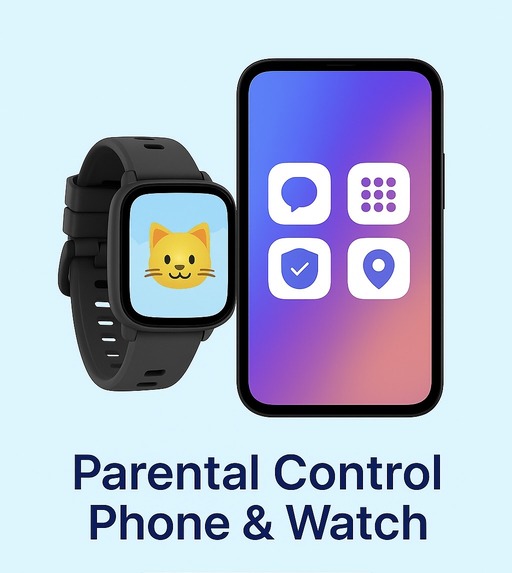
✔ Detects cyberbullying, predators, & threats
✔ Tracks real-time GPS location
✔ Sends instant alerts for risky activity
✔ Blocks explicit, violent, or unsafe websites
✔ Sets screen-time limits and bedtime schedules
✔ Lets parents approve contacts & apps
✔ Keeps data private & secure
Why Giving Kids a Smartphone Too Early Is Harder to Undo Than Parents Think
For many parents, the decision to give a child their first phone starts with good intentions. Safety. Communication. Convenience. The ability to check in after school or coordinate schedules. On the surface, a smartphone seems like the obvious solution.
But what many parents discover later is that giving a child a full smartphone too early is one of the hardest parenting decisions to reverse.
Unlike toys, activities, or even screen time rules, smartphones quickly become embedded in a child’s daily routine. They shape habits, expectations, and emotional responses — often before children are developmentally ready to manage them.
The Developing Brain and Digital Overload
Children’s brains are still developing critical skills such as impulse control, emotional regulation, and delayed gratification. These skills continue forming well into adolescence. Smartphones, however, are designed to demand attention, reward repeated engagement, and encourage constant interaction.
When a developing brain meets a device engineered for maximum engagement, the result is often imbalance.
Parents commonly report changes such as:
- Increased emotional reactions when phones are removed
- Difficulty focusing on homework or conversations
- Sleep disruption caused by late-night scrolling
- Heightened anxiety around notifications and messages
These patterns aren’t signs of bad parenting. They are predictable outcomes of giving adult-level technology to children who lack adult-level self-regulation.
Why “We’ll Just Limit It Later” Rarely Works
Many parents believe they can simply add restrictions if problems arise. In theory, this sounds reasonable. In practice, it’s extremely difficult.
Once a child becomes accustomed to unrestricted access, any new limitation feels like a loss. Removing apps, blocking websites, or reducing screen time often leads to resistance, arguments, and emotional distress.
This creates a cycle:
- Parents add controls
- Children push back or find workarounds
- Parents tighten restrictions
- Trust and cooperation decline
Instead of learning responsibility, children learn how to negotiate, bypass, or resent boundaries.
The Case for Starting With Less
Research into digital behavior consistently shows that how technology is introduced matters more than how much is used. Children who start with clear, consistent boundaries tend to develop healthier long-term habits than those who begin with unlimited access.
This is where parental control phones offer a different approach.
Rather than starting with a device that must later be restricted, these phones are intentionally limited from the beginning. They prioritize communication and safety while removing high-risk distractions like social media, app stores, and unrestricted internet access.
The result is not deprivation — it’s clarity.
Children understand what the phone is for:
- Staying in touch with parents
- Coordinating schedules
- Emergency communication
And just as importantly, what it is not for.
Reduced Conflict, Lower Stress
Another often overlooked benefit of parental-controlled phones is their impact on family dynamics.
Managing a regular smartphone requires constant vigilance: checking apps, reviewing screen time, updating settings, and enforcing rules. Over time, this monitoring role becomes exhausting and emotionally draining for parents.
With a phone that enforces limits by design, parents are freed from the role of digital referee. Rules are consistent. Expectations are clear. Arguments decrease.
Instead of negotiating every boundary, families can focus on trust, communication, and growth.
A Foundation for Future Responsibility
Starting with a safe phone doesn’t mean children will never get a smartphone. It means they earn expanded access gradually, based on maturity and responsibility.
This approach mirrors how children learn other skills — driving, independence, financial responsibility. Freedom increases as competence grows.
Parents who choose this path often report fewer regrets and smoother transitions later.
Because it’s always easier to add freedom than take it away.